Archive for February, 2008
For some wacky reason, I’ve had several people email me with ideas for Bumblebee this week.
Perhaps you’re all trying to tell me something?
My brother (who you can read about here and here) probably wasn’t thinking Bumblebee when he sent this, but I couldn’t resist sharing the photo of the redneck mansion he sent.

In a weird kind of way, I find this a rather stylish assemblage. I mean, there was some real thought to form and function. Umbrellas, a greenhouse, a pond, windmill and even seating. And you know how important I find seating.
I wonder if the flowers are real, plastic or silk?
March 31, 2008 Postscript: Wouldn’t you know it’s actually from a movie set? See here.
Robin
It seems that all the “women’s interest” magazines and daily newspaper style pages…
…always trot out a host of articles as we start thinking about warmer weather to give us tips on “spring cleaning.”

Is it just me or do you find the whole idea of “spring cleaning” silly?
Now, don’t get me wrong. There are seasons to my household activities. For example, in spring and fall I do rotate the clothes in my too-small closet so that the seasonal items are in easy reach. I am also one of those people you might call a “serial redecorator.” In the seven years we’ve lived in our house I have painted my bathroom four times. My office is getting painted for the third time today (a lovely pinky-taupe color that sets off the triple crown molding). I’m seriously thinking about chucking the office furniture for something more airy and streamlined. I switch out linens and artwork somewhere in the house nearly every week.
As the weather warms up, my redecorating naturally turns to the outdoors—creating new beds, sprucing up the garden furniture, raking, mowing…The list is endless, isn’t it?
You might be concluding that I’m pretty much on top of the whole cleaning thing—and you would be right. So I am absolutely sent to the edge of screaming when I see some of these articles that assume that everyone is in need of a remedial class on keeping a decent house.
Case in point…
That incredibly irritating magazine, Real Simple, must be for the simple minded or for those who need remedial lessons in housekeeping. Their website is featuring some of the most lame-brained articles I have seen yet on spring cleaning.
In an article called “Streamlined Spring Cleaning Plan” they tell you to “forget what constitutes a ‘proper’ spring cleaning, and instead take aim at visible dirt.” The article is full of spiffy hints such as “If your blinds and drapes have reached the ‘do not touch’ stage, turn them over to a professional.” They go on to advise you to clean out your kitchen cabinets by first emptying the contents onto the countertop. Duh.
Naturally, all of these helpful hints are accompanied by editor-picked products to help you do the job better.
Why, oh why, do we need to read a magazine to tell us to call the hazmat team if our drapes are so disgusting that we can’t touch them? I’m thinking that the folks whose houses have reached the decontamination stage of squalor aren’t kicking back to read spring cleaning articles in Real Simple in their free time.
One more example…
There’s a little article called “Maintain a Sparkling House in Just 19 Minutes a Day.”
Nineteen minutes. Apparently 18 won’t keep it sparkling like they promise. But 20 minutes is going overboard. Should we time ourselves to make sure we don’t over-invest in this whole house cleaning thing?
Oh, wait. Apparently so. I see now that they very helpfully outline a minute-by-minute plan for those 19 minutes–4 ½ minutes for the kitchen, 2 minutes for the bathroom, 6 ½ minutes for the bedroom and 6 minutes for the family room, living room and foyer.
I don’t know about you, but 19 minutes would not cut it around our house. With two men, two dogs, a cat and a fish named Pish living under the same roof, I’m organizing, scrubbing, laundering, airing, dusting, vacuuming, sweeping or ironing something pretty much every single day. And it can’t be done in 19 minutes and still allow me to call my house “sparkling.”
In case you’re wondering by now if I need medication for my obsessive-compulsive housekeeping disorder, let me assure you that I think I have it under control. However, I might need a little something for when all those magazines and newspapers start publishing their spring cleaning articles.
Robin
First, let me say that I am not a Martha Stewart basher.
I was not among those who took glee in the fall of America’s Domestic Diva. I acknowledge that it seems that she can be quite, uh, mean-spirited and brutal on her minions. But I also recognize that she has made some significant accomplishments. She has created a huge empire from nothing. She raised homemaking to an art during a time when high-powered careers were more in vogue. I also think she has suffered mightily from some highly publicized personal embarrassments—an icky divorce when her husband ran off with her former assistant and a financial scandal that probably wouldn’t have meant jail time for most investors.
So it’s not as a Martha-basher that I have decided to air my disappointments in her new garden.

The March issue of Martha Stewart Living was my first look at her garden at Cantitoe Corners, Martha’s newest renovation, a 152-acre estate in New York’s fashionable Westchester County. The article, “Fruitful Endeavors,” features her vegetable garden and, according to the author, some “clever and innovative techniques.”
Frankly, I’m disappointed in Martha’s Fruitful Endeavors.
First, Martha has chosen to surround the 90 by 150 feet garden with a seven foot-tall metal fence that looks more like it belongs around her former prison home than around a vegetable garden on an “estate.” I understand the need for a fence of some height. After all, those white-tailed deer can leap tall buildings in a single bound, right? But why a metal fence? There are so much more lovely alternatives.
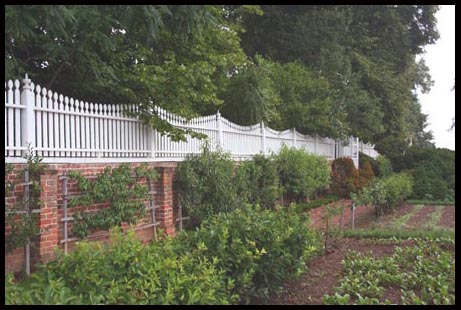
For example, how about the highly functional and also attractive fence surrounding the vegetable garden at Mount Vernon? George Washington designed this beautiful fence with a brickwork base and picket fence top. Despite the fact that it’s over seven feet tall, it doesn’t look like a prison exercise yard. Rather, the fence adds architecture and grace to the garden.
Second, the article boasts about her clever use of rotating crops. That’s “clever and innovative?”

What’s more, it appears that the vast majority of the garden is laid out in rows, or, as the article puts it, rows in a “rigorous geometry to yield maximum results and easy access.”
Why maximum results? As far as I know, she lives alone. Is she feeding a small nation army I’m not aware of? If not, why is she sacrificing beauty purely for the sake of “maximum” production?
I
t seems that old George (Yes, George Washington again.) was feeding a heap more people, what with the slaves and all. His gardens seemed quite productive and also managed to be a place that you could tarry as well as toil. Why must a garden only be for work and production?
Personally, I believe a garden should be as much for pleasure as for produce. (You can see more of my garden here.)

Finally, I see NOT ONE SINGLE PLACE TO SIT in her garden. Surely she must have a lawn chair stashed somewhere that she drags out when the photographers go home, right? And you know I value a place to sit in a garden.
Too bad about Cantitoe Corners. With Martha’s talent, money and hoards of help, her garden could have been something to rival the gardens of the likes of George Washington and Thomas Jefferson.
I’m sorry so say, Martha has let me down.
Robin
Isn’t it wonderful to be able to pursue a passion?
For me, it’s gardening…and birds…and books…and dogs…and cooking. For my husband, it’s horses. He wasn’t raised with horses, but he loves them. And despite his ultra-busy career, he has made time to learn to ride.

His instructor, Viviane, is a wonderful and witty woman I met at the gym several years ago. She was looking for students and Harry needed a private instructor because he was dissatisfied with the group lessons he had been taking. It has worked out beautifully.

Now, Harry and I have a wonderful marriage, but we give each other room for our separate interests. I take vacations without him sometimes. He retreats to his hidey-hole (what I call his home office) to think great thoughts. Our lives overlap some, but not a lot. We treasure our travels together and always sit down to to a home cooked dinner together. So don’t be surprised that it’s been several years since I have seen Harry ride. But last weekend I tagged along with my camera and was most impressed with the lovely setting, Viviane’s wonderfully encouraging instruction and Harry’s progress.

It doesn’t seem that long ago that Harry was just so very stiff in the saddle. And it was just a few months ago that he came home and proudly announced that he was able to get on the horse without the aid of a step stool. Now, Viviane is encouraging Harry to ride in a show this spring.

Today is my birthday. I am turning <bleeeeeep>. As I assess where I am in my life, I have some regrets. I have some unfulfilled promises to myself. But mostly, I am grateful that I am blessed with the kind of life that allows me to pursue my passions and a family that supports all the little quirks that go along with that.
Thanks guys.
Robin
Behind our house and beyond the garden is a messy field that needs attention.
It’s about three-quarters of an acre that used to be in hay production until the farmer who tends the rest of our field decided that I should mow it instead of him farming it. (Thanks for that.)
My husband would love to see a huge swath of neatly mown green grass. I haven’t yet convinced him that traditional lawns should be a relic of the past. The chemicals that must be dumped on them to keep them as pristine as he likes are bad for the environment, as are the emissions of my riding lawn mower.
The other option is just to let is grow scraggly grass. As ugly as that is, it’s very good for the environment and as a habitat for the wildlife.

A more manicured idea is to make it a wildflower meadow. But those don’t just pop up from seed and look picturesque without some serious seeding and tilling.
If I’m going to go to all that trouble, why not make it my own field of dreams? A lavender field of dreams!

Have you ever been around lavender in bloom? The scent is intoxicating! Heavenly! I grew lavender for a couple of years as the border in my herb beds before I had to tear them out to install the raised beds. As the lavender bloomed, the bumblebees would be everywhere, working slowly and peacefully around the lavender blooms.
Before they faded altogether, I cut bunches of lavender to place around the house and lined my drawers with the blossoms. I even made a pound cake with lavender scented water and lined the baking pans with the lavender blooms.
Then, there’s lavender sugar, lavender lemonade, lavender ice cream…

Lavender farms seem to abound judging from a Google search. Most of the farms at the top of the Google listings seem to be small artisan enterprises that also produce their own products. Well, forget that. There’s no time.
I wonder if there’s a market for pick-your-own lavender farms? Nope. I don’t want all those people down here invading my privacy.
Let’s see…Maybe I can grow it for some large-scale producer? Probably not. They would want me to meet some quality control standards or obey other rules. I’m not good at rules.
Perhaps…nah. Not that either.

Maybe I’ll just make some lavender borders for now…And get a lavender colored chair so I can sit and watch the bumblebees at work. And those lavender fields will just have to remain my field of dreams. At least for now.
About those Survey Results…
Have you cast your vote for how you would spend the $10,000 Donald Trump is going to give you? It’s interesting that so many people are choosing hardscaping. And although I made my case for nice garden seating, as of this writing no one has chosen furniture!
Robin
Kris at Blithewold recently passed along the E is for Excellent award to Bumblebee…
She said that she particularly appreciated the discussions of public gardens and parks and the encouragement given to go, enjoy, learn.

Thanks, Kris, for the recognition! As you know, blogging is a labor of love, but it’s also sweet to get compliments–and comments from readers too.
Apparently I get to pass along the award now, so I want to recognize the quartet of writers at Gardening Gone Wild. Nan, Fran, Saxon and Steve have been doing an excellent job of writing substantive and thought-provoking posts. I particularly like their design series that encourages reader participation. It’s been some of the most interesting garden blog reading I’ve run across.
Thanks again, Kris. I hope to make it to Blithewold soon! So many gardens…so little time!
BTW, if I could figure out the HTML to get copy to wrap around an image, that big E wouldn’t be so darned big. All the HTML code I’ve tried doesn’t work. Grrrrr. I don’t win any awards on my clever use of HTML code.
Robin
Every place I visit seems to have its own unique “green” character.
In London, I was charmed by the profusion of creative window boxes around the town. In France, I was amazed at the enthusiasm of small towns to “green” their city streets compete for prizes. Here in the U.S., I adore walking around Charleston and glimpsing into tiny jewels of walled gardens. In Key West I was enchanted by the exotic, luscious, tropical plants growing with wild abandon in the yards of even the most humble cottages.

One of the most charming cities with a unique garden appeal I have visited is Amsterdam. The city of 12,000 bridges and 160 canals is also home to about 2,400 houseboats that line the canals and waterways around the Netherlands’s capital. Houseboat living became popular in the 1950s during a shortage of affordable housing. As boat owners upgraded their old and dated barges for larger and more modern vessels, ingenious and thrifty folks bought the barges and converted them into floating homes.
Despite the fact that they traded in earth for water, many of the houseboat dwellers still have gardens. Visitors to the city can tour the canals in well-narrated tours. But the narrative is just noise when you start snapping photos of all the picturesque waterways and the homes.

Not a few of the houseboat dwellers had converted portions of their decks into tiny but traditional gardens by carting in loads of dirt to create a replacement allotment. Most, however, were container gardens. Beautification of their aging vessels seemed to be important to many, as containers of geraniums, daisies and, of course, tulips were abundant.
Many of the houseboat dwellers had productive pots of tomatoes and herbs. Some of the canal dwellers just seemed to be giving their houseplants a good airing.
Amsterdam is a wonderful and inviting walking city. The streetscapes are safe, clean and lined with interesting plants. But the canals are what draw the eye and the imagination.

For me, it was a lesson in “make blooms where you are planted.” Regardless of how humble your abode or challenging your growing circumstances, create a bit of beauty to brighten your day and the day of those who see your home.
I certainly wish more of our American suburbs and small towns would take the lessons of our European cousins. A bit of greenery and flowers is not just beautifying. It sends the message that someone cares about the place where they go at night and raise their families.
Robin
So, naturally, I have been counting birds.

Okay, I stopped to take some photos too.
The Great Backyard Bird Count is a special four-day count over President’s Day weekend. Last year more than 81,000 checklists of birds were supplied by backyard bird watchers. The Project Feederwatch program gathers data that assists scientists understand bird populations and migration patterns.
Here at Bumblebee, we seem to have an abundance of American Goldfinches this weekend. At one time I counted more than 30 at the feeders. We also had a flock of redwinged blackbirds that I’ll get to report. I estimated their numbers at 170 using a grid count method. And the overall bird visitation has been so brisk that I’ll have to head to the Wild Bird Store yet again to pick up some of my pre-ordered food.
Of course, we have our usual visitors, including a particularly grouchy Carolina Chickadee. She was mighty upset when my cat, Miss P, and I wandered outside with the camera.
It was overall a good day to be outside. Tomorrow I’ll be making my own President’s Day celebration. Tune in sometime soon.
Robin
“Butterflies and Plants: Partners in Evolution,” the Smithsonian’s new long-term exhibit at the National Museum of Natural History…
…opened today in Washington, D.C. In the works for 18 months the new structure is the only year-round indoor butterfly pavilion in the D.C. area.
Aside from the oooh-aaaah factor of so many butterflies, the exhibition uses video and interactive displays to give visitors a look at how butterflies and plants have successfully evolved, adapted and diversified together.

MONARCH SIPS NECTAR FROM A ZINNIA
Inside, the pavilion is kept at a 80 degrees and 80 percent humidity. Tropical plants provide a lush environment for the guest insects. All the walls are curved in order to keep the butterflies from being trapped in corners. Dawn happens gradually for the butterflies in the morning and sunset gradually descends in the evening. All-in-all not a bad way for a butterfly to live.
More than 300 butterflies and moths of more than 30 species and from as far away as Africa, South and Central America and Malaysia will reside here at a time. They’re first put in an emergence chamber where you can actually see the final state of metamorphosis and watch the butterflies take their first flights.

OWL BUTTERFLY
Exhibit curators replenish the supply regularly from shipments of chrysalides from around the world because the butterflies and moths are not allowed to reproduce because of strict USDA regulations. Eggs that are deposited are removed and destroyed.
And now for the controversy…
Of course, nothing happens in Washington, D.C, without some controversy. It seems this butterfly exhibition has been the catalyst for a controversy on museum admission fees. For the first time in its history the Smithsonian is charging admission for a permanent exhibition—between $4.50 and $6.00. Museum officials say that this will help to cover the nearly $1 million it costs to keep maintain the exhibition.
But since the Smithsonian is largely funded by the federal government (about 70%), some people have their panties in a wad about having to pay anything at all to get in. Delegate Eleanor Holmes Norton has even introduced a bill that would prohibit the institution from charging admission for any permanent exhibition. (I like Eleanor. But this isn’t one of her smartest moves.)
Since I worked in a major art museum for nearly five years, I can speak with some authority when I say that museums all over are struggling. Government support is down and private donations for the arts must compete with a proliferating number of humanitarian causes among donors. And running a museum is a very expensive proposition.
The Smithsonian has been in the news for several years now for the appalling state of some of its aging facilities. Artwork and historic objects don’t just take care of themselves. They must be maintained in climate controlled environments, cleaned and preserved. Security must be provided to keep the treasures and the huge numbers of people who visit them safe.
All that takes money. Sadly, it’s not realistic to think that taxpayers can pony up any more dollars to prop up this wonderful but aging national treasure. The money must come from somewhere. Selected admissions fees seem a sensible idea. It will allow the museums to maintain collections and continue their work to make the national treasures accessible.
The wealth of free attractions in the D.C. area is astounding. But just because something is free, doesn’t mean it doesn’t cost money to maintain.
Climbing down off the soap box now…
Anyway, I digress. If you’re interested in visiting the exhibition, you can learn more about it here. You can also see some of the butterflies from the exhibit in the photo section of this blog.
**Photos were supplied by the National Museum of Natural History
Robin
For me, there’s nothing like seeing the real thing to learn about plants.
That’s one of the reasons I make visiting botanical gardens, parks and flower shows a high priority when it comes to travel and my free time. Aside from the enjoyment of being outdoors or seeing all the wonderful new combinations, I can see the three-dimensional version of the plants in a natural setting. I can see their real size and color. I can smell, touch and feel the plant.
When I look at the flowers and plants in magazines and catalogs all seem to run together after a while. The photographers make them all just lovely. And how can you really judge color or size in print? Forget about smell.
When I’m visiting a park or garden I will sometimes photograph a particularly striking arrangement with the plan for making a similar arrangement at home or just to add to my photographic idea book.
Here’s an example. On the left is a container arrangement I saw at the Dixon House and Gardens in Memphis last May. I was particularly taken by the holly, primroses and parsley packed into the beautiful pot. The unusual shape of the holly made a dramatic statement in the container arrangement and added some vertical interest.

On the right is a version of the same arrangement I made at home with flowers I found at the local garden center, including a sky pencil holly and some miniature petunias. I didn’t have the fabulous container they had at the Dixon gardens, so a simple terra cotta container had to do.
Could I have gotten such an arrangement idea from a book? Sure. But by actually seeing and copying an existing arrangement, I had a much better idea of the outcome to expect.
I haven’t had nearly the same success with packages of plants sold to create specific effects. White Flower Farm has some spectacular arrangement collections and photographs that make me salivate. They are drop-dead gorgeous. Still, I’m not buying them anymore though because I can never recreate the same effect in my garden. It’s frustrating to spend a lot of money on plants and then be disappointed in the outcome. I’ll save my money for seeds, fabulous pots and plants I can be confident will do well here at Bumblebee.
Of course, not all of the arrangements here at Bumblebee are copies. But I think copycat gardening is a good strategy for learning about plants until you’re ready to fly solo.
Robin