Archive for March, 2008
At the risk of flogging a dead horse (a hideous expression, don’t you think?)…
I want to make an appeal to those well-meaning but misguided folks who assemble the bouquets at our corner florist shops. And I especially appeal to the corporate creative department at FTD, which fuels and/or dictates much of the design aesthetics for these small business owners.
You know the people. They make things that look like this…

Or this…

Or even this…

In the name of God, please STOP!
What you are doing is an abomination. It is a blasphemy against the laws of nature and how God intended plants to grow. Have you ever visited a garden? If so, did you EVER see all of these plants lined up uniformly in a symmetrical orb with no stems, leaves or branches–resembling a basketball? Must you reduce Baby’s Breath and ferns to an afterthought? And why must containers be so very sweet? Do we really need flower arrangements that look like ice cream sundaes? Carnations colored into fluorescent hues of green or orange? Teddy bears hugging our tulips?
Mr. or Ms. Florist, can you please pick up a couple of design magazines and see what is au courant? It’s not this tightly packed, overly-colorful, cheap flower arrangement that are the equivalent of the super-tight permanent wave cranked out at smelly “beauty parlors” in small towns in our fair land.
We have a local florist that my husband, until recently, faithfully visited for my birthday, anniversaries, Valentine’s Day and other important occasions, including when he was in the Dog Haus. I dropped by recently because they had a sign advertising a good deal on tulips. Frankly, I can only conclude that these people do not actually LIKE flowers.
As I entered, I had to pass all manner of “arrangements” that would make the average weekend gardener convulse. It was like entering a flower torture chamber. They were packed, crammed, twisted and contorted into every manner of unnatural pose imaginable. When I finally made it to the bargain tulips, I could hardly breath.
“Let me out of here. You’re hurting me!”
To be sure, the FTD folks seemed to have hired at least one younger-than-80 creative person. They now offer minimalist arrangements by Todd Oldham and Vera Wang. But, really. $110 for an orchid that I can buy at Lowe’s for $20? There is a way to go before you’re there, FTD.
Let me recommend a book for your education and edification. It’s called Zen Flowers, by Brenda Berkley and Anulka Kitamura. It is filled with examples of airy, simple and tasteful arrangements that honor the original plants and do not involve torture devices or demeaning containers.

And guess what? The author actually owns–a FLOWER SHOP! And she makes a living selling designs such as this…

And imagine a home with flower that look like this…
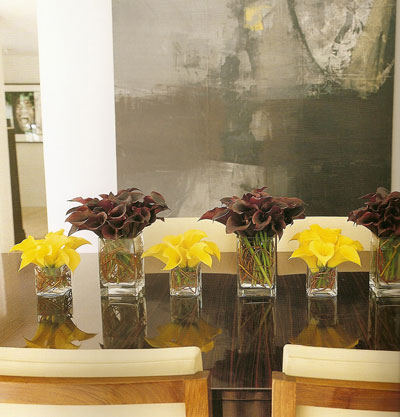
I know that Ikebana may not be for everyone. And I acknowledge the commenter from my previous post on the topic who said that there are some flower-buyers who expect quantity rather than quality. But I also believe that it is incumbent on florists to help educate their customers on nature and taste. Do you reall WANT to torture all those tulips? Pervert those petunias? Wrestle those roses?
But I am hoping that someday we can banish mounds of ice cream sundae flower arrangements or flowers in yellow smiley face cups. I hope that as gardeners we can help educate our friends and families that a simple arrangement in a humble, but natural container, is more aesthetically pleasing than a tacky ceramic container made in China. I would prefer some spring daffodils in a recyclable aluminum can to the overly-wrought arrangements that contort and distort nature.
Please, oh please. Let’s make the pledge now. No more hideous and unnatural flower arrangements…
(Okay, I acknowledge that I seem to be a wee bit cranky right now. Mi dispiace. I seem to be time-stressed, which is completely contrary to my continuous improvement efforts to simplify and slow down. That said, in the way of excuses, I have a lot of travel ahead in April–my prime gardening month. I am heading to Austin for the garden bloggers Spring Fling after which I head directly to San Francisco for some focus groups. I land home for barely a week before heading off to Geneva, Switzerland, for more focus groups. I know…sounds great until you contemplate my client’s coach-fare policy and the fact that my garden needs some serious remedial work in April. Oh, quit it with your tiny little violins…I’m serious here. This time.)
Robin
I don’t think I’m particularly obsessed with things being perfectly trimmed and even in my garden…
I always tell people that a little bit of wildness breathes life into a greenspace. This philosophy also happens to make it easier to justify the times when I don’t exactly get everything done to perfection in the garden. There isn’t time to do everything and to do it well, so a laissez-faire policy seems to work as well as any to justify what I do (or don’t do).
So I have to wonder if I have the discipline and patience to accomplish a topiary. Can I do all that training and trimming and spritzing and pinning? Do I even have the time?
I may have to give it a try. I have fallen in love with green dogs–topiary dogs.
Take a look at this pooch from the Philadelphia Flower Show, accomplished with multiple varieties of ivies. Some are solid and some are variegated. See the little pine needle sprigs for his whiskers?

There was a whole topiary dog park at the flower show, complete with the obligatory fire hydrant. Some were sniffing and some were playing. I thought this fellow lolling on his back for a tummy rub was clever.

Since I adore dogs, I think a nice green dog would be a wonderful addition to my garden. And I have extraordinary patience with my real dogs. Perhaps that would transfer to a topiary dog.
Wait. What’s this?

Nice try, Sarah, but topiary dogs are green, not brown.

Um. Okay, you’re partly green now. But you’re still not a topiary dog.
Robin
I am just crazy for anything I can grow and eat here at home…
…particularly in the winter, when the weather is inhospitable for gardening or even venturing out to a favorite restaurant. I keep herbs on the kitchen counter. That’s also why I sprout everything from wheat berries to mung beans to adzukis to alfalfa to add to breads, salads or other dishes. Sprouts boost the taste AND the nutrition in one fell swoop. So when I saw the recent proliferation in seed catalogs for microgreens, the cartoon light bulb over my head lit right up.

KA-PING!!! I bet I can grow these in my light garden! Then I can have gourmet greens in my own kitchen 12 months out of the year. Why didn’t I think of this before?
To get started, I ordered a set of microgreens seeds from Cook’s Garden, which included Beet Bull’s Blood, Broadleaf Cress, Kohlrabi Chancellor, Cutting Celery, Pea Green Arrow and Spinach Rembrandt. Each seed was packaged separately. Cost: $13.95 for six typical packets of seeds–.4 grams to 2 oz each. I also ordered the spicy microgreens mix from the Sprout People, which included Daikon Radish, Cress and Arugula. These seeds were mixed together. Cost: $9.95 for a one-pound bag of organic seeds.
Clearly, the Cook’s Garden quantities were minuscule compared with the Sprout People seeds, especially when you consider that the plants aren’t going to mature to big plants, but will be hacked off at the roots and eaten as baby plants. You will need quite a lot of seeds for microgreens.

I planted one box of soilless potting mix with the Cutting Celery and Broadleaf Cress from Cook’s Garden and one with the seed mix from the Sprout People. All of the seeds sprouted and grew beautifully in the light garden in just a few days. I was able to clip off just what I wanted to add to salads or to add atop sandwiches. The sprouts have stayed crisp, fresh and zingy for several weeks while I continue to clip them. Fabulous!

If you want to try your own microgreens, you can plant them in traditional plastic sprouting trays on a windowsill or under grow lights. The Sprout People also offer a hemp bag sprouter that looks quite handy and can be used for microgreens.
So now I can have teeny tiny salad greens year round. Now that’s a fabulous find!
Robin
Have you grown hellebores yet?
I have long been a big fan of hellebores. I planted ours about four years ago. They were a bit slow to get established, which apparently is not altogether unusual. Then last year–their third year–they took off. This year they are really making a show of themselves. I tidied mine up yesterday and thought I would do a little show and tell. But now I can’t resist a bit of hellebores boosterism too. So if you haven’t yet added some to your garden, let me offer seven reasons why you should.

1. Hellebores can be grown in a variety of locations. They are most famously known as shade plants. That is true. They do grow nicely in the shade, as you can see from the hellebores on the north side of our house. But they are very flexible plants and will bloom very nicely, thank you very much, in partly sunny areas as well.
2. Hellebores bloom very early. Here in Maryland they bloom in February–long before the forsythia and daffodils make an appearance–and last well into summer.
3. Hellebores are green all year long. Unlike some perennials, such as irises, that get unsightly after the blooms are spent, hellebores keep up their appearance even in the coldest and hottest months of the year.

4. Hellebores require little care. Once you have established hellebores in a well-prepared bed, the only maintenance required is trimming off the old foliage in February or late winter or when they become scraggly. Divide them in the spring to ensure good ventilation.
5. Although not the boldest colors in the garden, hellebores come in a variety of colors, from white to pink to deep purple to green.

6. Hellebores have relatively few pests and diseases. Although no plant is invulnerable to attack, hellebores are amazingly hardy.
7. Once established, hellebores are drought tolerant. And if you lived through the drought last summer like I did, you know there are lots of other plants that are much more finicky about their water than hellebores.

Are you convinced yet? And if you have them, how are you hellebores?
Robin

Colleen V. at In the Garden Online established these awards to recognize excellence in “online gardening.” You can vote for for up to three of your favorite blogs in each category by going here. There are categories in:
-Best writing
-Best photography
-Best design
-Most innovative
-Blogger you’d most like as a neighbor
-Best gardening podcast
-Best North American blog
-Best international blog
-Best new blog
-Post of the year
-Garden blog of the year
-Best forums
-Best gardening site of the year
I already have most of my nominations decided. But it’s not too late for you to woo me with cookies and pies to submit your blog. I can be bought we sweets! I’ll wait until near the deadline to send in my votes so you don’t have to pay for FedEx to get all the treats to me in time.
We all need to get our votes in by April 13. Don’t worry. You’ll still have two days to do your taxes!
And while you’re voting, don’t forget to have your say about blog posts on garden products here on Bumblebee. The poll is in the upper right hand corner of this page.
Now go vote!
Robin
Some images just stick with you…like the idea of eight million bees loose on the freeway.
This story came out of California a couple of days ago. It seems that a truck hauling 440 colonies of bees overturned–setting loose EIGHT MILLION BEES! That’s an image I can’t get out of my mind. Take a look at the photo at the bottom of this news story.

It seems that the big rig that was hauling the bees home overturned, setting loose all the flying critters. It shut down traffic for hours while several other beekeepers–WHO HAPPENED TO BE PASSING BY THE ACCIDENT–wrangled them back into the colonies to be hauled away.
The good news is that bees are very orderly creatures. Once the hives were set up the buzzing bees rendez-voused with their brethren so they could be transported to their next job. Some bees were lost. And it will take a while to sort out the whole one-queen-per-hive issue. But for the most part, the cool-headed beekeepers efficiently dealt with eight million potential problems fairly handily.
First, I didn’t know that there were itinerant bees. I thought that bees were pretty much home-based and took care of their own fields and crops. But these bees were apparently being trucked back to Washington state after a gig in the San Joaquin Valley.
Second, who knew that there were so many bees a coming and going that there would be more than one big bunch of beekeepers on a single stretch of California highway? What are the chances? Well, apparently pretty good in California. But then, California is a special place, no?
My head is still buzzing with the thought of eight million bees on the loose.
Robin
After viewing the exuberant displays of flowers, plants, containers and hardscaping…
…the visitors to the Philadelphia Flower Show were practically foaming at the mouth in the vendor area. I have never seen so many women carrying around bunches of pussy willow in my whole life. They looked like some sort of bizarre religious procession with the waiving branches and the ecstatic looks on their faces.
Well, since I have actually planted my very own pussy willow bush, I shopped for other things. Here are some of Robin’s Fabulous Flower Show Finds.

A couple of days ago I talked about how I am just mad for Ikebana, the Japanese art of flower arranging. Don’t call the Ikebana police on me, because I’m quite sure I have broken some Ikebana rules, but I bought an Ikebana vase and gave it a try here at home.The trick with this nifty little vase is a built-in “frog” at the bottom and an enclosed water well. I don’t have the source for you, but you can search for Ikebana supplies on the Internet and find many similar vessels for your own Ikebana creations.

I have always found that my plants are much happier (ergo I am a better gardener) when they are in clay pots. Unfortunately, it is exceedingly difficult to find a stylish clay pot. They are all so mass-produced looking and utilitarian. So I was just tickled pink to discover Goff Creek Pottery. These pots are about 10″ high and cost $40 each. Goff Creek has many larger pots, including huge and decorative urns that go for up to $800. Sadly, there was only so much my husband was willing to carry for the sake of my gardening habits.

I also met a wonderfully charming couple with a tiny little booth of pottery vases. Paula L. Brown-Steedly, at Virginia Clay, is the potter and seems to specialize in organic-looking, hand-built clay vessels, although she also had a number of thrown and thrown and manipulated vessels. I purchased these two vases, about 11″ high each, at about $85 and $70. They look fabulous with a simple arrangement on my farmhouse table.

Do you love African Violets like I do? Well, let me introduce you to the Violet Gallery. They only had about 20 of their violets on display and for sale. But their catalog is 16 pages of mouse type with HUNDREDS of different types of violets. I was just crazy about the variegated varieties, but managed to restrain myself and only brought home four at $4.95 each. In the catalog, the cost is $6 each. Specimens are extremely robust. Highly recommended!
I love fashion. Unfortunately, fashion and gardening don’t mix so very well. I mostly wear jeans or shorts, a tank top and sneakers. I love the look of those British knee-high boots, but frankly, there is just no need for them here. So I get my jollies with gardening gloves and justify the purchases by telling myself how useful they are.
But don’t you hate gloves? I would much rather dig my fingers into the dirt and rip out those wretched weeds with my own bare fingernails. Unfortunately, it’s not quite right to traipse into a focus group room or conference room with raggedy and dirty nails. So I have (mostly) learned to use gloves. I prefer gloves that don’t feel like gloves–I want them snug, but not tight. Thin, but not flimsy. I don’t like rubbery barriers. I want to be able to FEEL what I’m doing. (Ahem.)

Well anyway. I adore these Atlas Gloves. They are, indeed, soft and supple. I can hardly wait to give them a test drive. At $7 they are a bargain. I may have to order in bulk.
BTW, you may notice that these are a size small. Since I am 5′10, I do not have small hands. So if you cannot find these gloves locally and decide to order them, know that they run VERY LARGE.
Isn’t shopping so much fun?!?!
Robin
One of the advantages of signing up for the early morning tour of the Philadelphia Flower Show…
…aside from being able to see the displays without having to jostle, stand on tippy toe and elbow my way through the hoards—was that the guide was a seasoned flower show volunteer. Our guide was a charming older fellow who seemed to know everyone on the floor and lots of stories that won’t necessarily make the official news. Here are some stories you won’t read about in the newspapers about the Philadelphia Flower Show…some his and some from my own observations.
One exhibitor at this year’s show, a nursery, didn’t win any of the judges’ prizes but did win the several of the popular vote awards among visitors, the People’s Choice Awards determined by written votes each day. The display was a music instrument repair shop, in keeping with the show’s New Orleans and jazz theme. A wildly popular fountain of repurposed brass instruments was a focal point, as was an old upright piano remade into a waterfall and a tuba fountain.

I was amused to hear the booth representative explain not once, not twice, but three times how no instruments were harmed in the making of the display—they were all old and useless anyway! It seems that some people had been complaining about how the nursery had destroyed instruments for the purpose of the display.

Our guide told us about one exhibitor in the nursery class, the J. Franklin Styer Nurseries Inc, a Philadelphia-area nursery that was recently purchased by Urban Outfitters as part of its quest to launch its outdoor chain Terrain. (If you haven’t heard about it, the goal of Terrain is to “to transform the local garden center into an experience that celebrates the beauty and abundance of nature while offering an eclectic mix of garden-inspired products tailored for the contemporary customer.” Watch out Smith & Hawken.) The purchase occurred just three weeks before the Philadelphia Flower Show, where the nursery has for years had a major display area. The nursery’s designer and flower show coordinator promptly quit, leaving the nursery—and Urban Outfitters—with just three weeks to fill a big hole that other companies spend months and months designing and planning.
Well, don’t underestimate Urban Outfitters and their desire for an untarnished reputation and a smashing 2008 launch for Terrain. Within a week they had hired a Hollywood set designer and came up with a stunning display that won Best of Show for the nursery division. Sadly, my photos don’t to justice to the display, which included a stunning Bougainvillea with vines as thick as my arm winding up on to a porch. It was breathtaking.

Our guide is also a member of the Philadelphia Men’s Garden Club. He said the club was formed because years ago there were only ladies clubs and the fellows felt outnumbered and misunderstood. With their own club, he said, “We can break all the rules and drink beer while putting up our display.”
Their display, in the by-invitation division, was a men’s private club in a swampy setting, complete with alligators swimming in the waters around the clubhouse and a porch sign that warns, “Beware! Poker Players and Loose Women.” I gave them high marks for creating a display appropriate to the group.
Our charming guide pointed out one nursery display that was heavy on salvaged pine trees. It seems that a while back the nursery owner broke his hip, lost is wife and his business. It was a very bad year. The Philadelphia Men’s Garden Club swung into action, passed the hat and collected some money to help with the doctor bills. They found a surgeon to do the hip replacement for free and even pitched in to complete some of the unfinished nursery work. Now, our guide proudly pointed out, the nursery owner was back in business and once again exhibiting at the flower show—an example of the camaraderie and support among the show folks.

The Best in Show award for the best florist went to the entrant who decided to suspend their display from the ceiling—the first time for such a “daring display.” Thousands and thousands of individual flowers in florist vials were arranged into a kind of chandelier cum mobile. Painted footprints on the floor indicated where visitors could stand to hear music under one of the three suspended floral arrangements.
Although he was an entertaining guide, his enthusiasm for the show is better than his hearing because he seemed to think the music was on when only the electric lights were buzzing. “Isn’t that fabulous?!? It’s beautiful!!! Listen!” I had to smile, but a young woman in our tour group kept yelling in his ear, “It’s the LIGHTS! It’s the LIGHTS!” Aren’t people funny?
Here are a few more photos from the show…


Okay, that’s it for the Philadelphia Flower Show stories except for a few choice finds that I found in the vendor area. Coming up!
Robin
There are flower arrangements and then there are flower arrangements.
Personally, I detest the overly-colorful and tightly packed arrangements that I associate with almost anything you can order through FTD. I have finally trained my husband to get a bunch of fresh flowers from the florist–or even the grocer–that I can arrange at home in my own lovely containers. But Ikebana is another matter altogether. Take a look at these displays from the Philadelphia Flower Show and tell me what you think. They are competitive examples of Ikebana, the Japanese art of flower arranging.
You won’t find abundant and exuberant displays of bountiful blossoms. This is all about line and form. Restraint even, from what I can tell. And the container is as important as the arrangements, which often rely on twigs or other materials to make a line to draw the eye and create the form. Frankly, I find the arrangements artful and, well, refreshing.
Those exceptionally sophisticated and informed folks up in Philadelphia even have a local chapter of Ikebana International. I saw some of the participants spending about 45 minutes on their arrangements, which had already been judged, trying to improve them, gently twisting a twig here, adjusting a flower height there. This is flower arranging for the exceptionally patient.
I spent a good deal of time examining these arrangements before heading off to the vendor section to pick up a couple of “vessels” for my garden flowers. I adore the fact that you don’t have to have dozens and dozens of blossoms to make a beautiful arrangement and that you can use other materials–even dead stuff–to an artistic end. Right now, I have a good deal of dead-looking stuff to use in arrangements. While I doubt that I’ll ever spend more than 10 minutes on an arrangement of flowers, I do believe I have picked up a trick or two from the Ikebana aficionados.
With that said, here’s a little Ikebana walking tour from the Philadelphia Flower Show for you…


I’m fascinated. What do you think? Is Ikebana for you?
Robin
I just returned from the Philadelphia Flower Show. Holy moly.
Let me tell you, this is no ordinary home and garden show. Nay, nay. This is a spectacle! It costs the fine folks of the Pennsylvania Horticultural Society about $6.5 million to put on the show, although the estimated total expenditure by the show as well as the participants is three times that. The show covers a total of 10 acres in three areas: major exhibitions, competitive classes and horticultural schools and universities. There is also a large vendor area where you can shop till you drop.
Profits from the show go to benefit the Philadelphia Green program, which cleans up and beautifies outdoor spaces that have been derelict and unsightly. The program also sponsors a prisoner gardening program to raise vegetables for the homeless, neighborhood and community gardens and loads of education programs. Many cities could look to this program as a model of excellence with many side benefits.
This year’s theme was all about New Orleans and Jazz. The entrance was a recreation of the famed Bourbon Street, all decked out in flowers.

The competitions are in areas for landscaping, floral design, florists, by-invitation and by individual plant species. Many local high schools and colleges participate in the program, as do some prisoner groups.

In addition to the huge displays, there are also fabulous displays of smaller competitive areas: window boxes, container gardens, Ikebana, competitive impromptu arranging, stoop gardens, table settings…the list goes on and on. One of the most amazing areas was the miniatures–tiny little dioramas of natural and indoor scenes with real, live, miniature plants.
The Philadelphia Flower Show claims to be the biggest and best in the U.S. and is distinguished from the famed Chelsea Flower Show in London because the Philadelphia show is indoors. Chelsea is outdoors. That means that all the flowers, flowering shrubs, flowering trees–everything–had to be forced indoors. If you have ever tried to force a flower, imagine trying to force thousands, if not millions, of them. All at the same time. All on a particular day. And then arranging them in a small exhibition space to please the judges and the crowds.
And that, my friends, is why they call it a “show.”
(By the way, I arrived home just in time to unpack and pack again…off to Atlanta this time. I have about 1,000 photos to wade through, but will be posting them as soon as I return and recover. I also want to show you all the cool new stuff that I bought!)
Robin